
Exploring Spectra Symbol’s Potentiometers
Author: David Marriott, Spectra Symbol CEO
A comprehensive guide to what a potentiometer is, how it works, and how different Spectra Symbol products compare — with examples and project ideas.
I. Introduction — What Is a Potentiometer?
If you’ve ever adjusted the volume on a radio or dimmed a light, you’ve likely interacted with a potentiometer without realizing it. But what is a potentiometer exactly? At its core, a potentiometer is a three-terminal variable resistor that functions based on the voltage divider principle. It allows you to adjust resistance by moving a wiper along a resistive track, which in turn changes the output voltage.
The wiper, or sliding contact, divides the total resistance into two parts, enabling precise control over the electrical signal. When using all three terminals, it acts as a potentiometer for voltage division; with just two terminals, it behaves like a rheostat for current control.
Potentiometers find typical applications in everyday devices, such as controlling audio volume, adjusting screen brightness, or sensing positions in machinery. For a deeper dive into the basics, check out Spectra Symbol’s overview article on Potentiometer Symbol, Function, and Applications.
A. Voltage Divider Explained
In simple terms, as the wiper moves along the track, it creates an adjustable voltage output. Imagine a fixed input voltage split proportionally based on the wiper’s position—no complex equations needed, just a straightforward analog adjustment.


B. Mechanical vs Electrical Roles
Mechanically, potentiometers often feature a knob or slider for user input. Electrically, they serve as sensors in circuits, providing feedback on position or adjustment levels.
II. Major Potentiometer Categories (General Overview)
Before exploring Spectra Symbol’s specialized offerings, it’s helpful to understand the broad categories of potentiometers. These help bridge the gap from basic concepts to practical product types.
Rotary potentiometers: Feature a mechanical knob for circular adjustments, ideal for volume or tuning controls.
Linear potentiometers: Use sliders for straight-line movement, common in faders or position tracking.
Membrane potentiometers: Thin, flexible designs activated by pressure, suited for compact or touch-sensitive applications.
Flex sensors: Bendable resistors that change based on curvature, extending beyond traditional pots for motion sensing.
Magnetically actuated potentiometers: Contactless operation using magnetic fields, enhancing durability in harsh settings.
This overview sets the stage for how Spectra Symbol innovates within these categories.
III. Spectra Symbol Potentiometer Families — Product Depth & Comparison
Spectra Symbol offers specialized potentiometer technologies tailored for modern designs, from thin flex sensors to magnetically actuated precision devices. Each type addresses unique engineering challenges, ensuring reliability and integration ease. Browse the full range at Spectra Symbol’s official sensor store.
A. SpectraFlex Flex Sensors
What it is: Flexible resistive sensing that changes based on bend angle and curvature.
How it differs: Not a traditional voltage-divider potentiometer with a sliding wiper—it acts like a variable resistor affected by bending motion.
Pros:
Flexible and conformable
Good for wearable and enclosures
Thin and lightweight
Cons:
Not linear like a slide pot
Not a position sensor (measures curvature)
Applications:
Wearable motion sensing
Robotics joints
Rehabilitation monitoring
For more details, visit the SpectraFlex product page.
B. Original Flex Sensors
What it is: Earlier generation flexible potentiometric element similar to SpectraFlex but with distinct resistance ranges or form factors.
How it differs from SpectraFlex:
Possibly wider sensing range
Differing resistance values
Pros / Cons: Similar to SpectraFlex but with subtle differences for specific choices.
Applications:
Projects requiring flexible motion measurement
C. SoftPot (Linear & Rotary)
What it is: Pressure-activated membrane potentiometer with continuous analog response.
How it differs: Unlike rigid slide potentiometers, SoftPot uses a thin membrane with a wiper activated by pressure—ideal for ultra-thin or curved surfaces.
Pros:
Ultra-thin form factor
Sealed membrane (less mechanical wear)
Easy integration into curved or compact spaces
Cons:
Requires pull-down and thoughtful idle handling
Pressure must be applied for contact activation
Applications:
Human-machine interfaces
Audio sliders
Medical control panels
Compact robotics controls
Explore the SoftPot product page or the Thin and Flexible Potentiometers overview (ThinPot™ & SoftPot™).

D. MagnetoPot (Linear & Rotary)
What it is: Magnetically actuated potentiometer—moves via external magnet, no physical sliding wiper contact.
How it differs:
Contactless variable potentiometer
Uses magnetic field to determine resistance change
Pros:
Extremely durable (no mechanical wear)
Good for sealed or harsh environments
Cons:
Requires magnet alignment and integration planning
Applications:
Industrial position sensing
Robotics actuators
Harsh environmental controls
Check out the MagnetoPot product page.
E. HotPot (Linear & Rotary)
What it is: High-temperature tolerant potentiometer designed for demanding environments.
Pros:
Withstands higher temperature or mechanical stress
Cons:
More specialized, over-specified for simple control tasks
Applications:
Industrial control
High-heat applications
View the HotPot product page.
F. Custom Linear & Custom Rotary Potentiometers
What they are: Made-to-order potentiometers tailored in length, resistance, mounting, environmental sealing, and connector types.
Pros:
Precision matched to design needs
Configurable electrical and mechanical parameters
Cons:
Lead times and design preparation
Applications:
Automotive prototype testing
Custom robotics mechanisms
Embedded products with unique form factor requirements
Contact for custom options via the custom potentiometer request page.
IV. Product Comparison Table
| Product Type | Motion Detected | Typical Form | Durability | Precision | Best Fit Applications |
|---|---|---|---|---|---|
| SpectraFlex Flex Sensors | Bend | Flexible | Moderate | Moderate | Wearables, robotics |
| Original Flex Sensors | Bend | Flexible | Moderate | Moderate | Prototyping |
| SoftPot | Linear/Rotary | Membrane | High | High | UI sliders, panels |
| MagnetoPot | Linear/Rotary | Magnetic | Very High | Very High | Industrial/harsh |
| HotPot | Linear/Rotary | High-temp | Very High | High | Industrial heat |
| Custom Linear/Rotary | Custom | Various | Varies | Varies | Tailored applications |
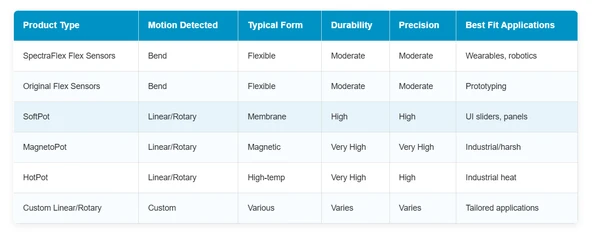
This table highlights the key differences to help you quickly identify the right fit.
V. Potentiometer Examples & Project Ideas
To bring these to life, here are project ideas paired with Spectra Symbol’s potentiometers:
SpectraFlex: Build a wearable bending sensor for arm or knee motion capture in fitness tracking devices.
Original Flex: Create a DIY posture sensor for ergonomic monitoring in office setups.
SoftPot: Integrate into an Arduino synth project for smooth slider controls on audio effects.
MagnetoPot: Use for rotary actuator feedback in automated assembly lines.
HotPot: Implement temperature-resilient controls in motor drives for industrial machinery.
Custom Pots: Design a unique control panel for medical prototypes or specialized embedded systems.
VI. Choosing the Right Potentiometer for Your Project
Selecting the ideal potentiometer depends on several factors:
Motion type required: Bend for flex sensors, rotary for knobs, linear for sliders.
Space constraints: Opt for ultra-thin membrane or flex options in compact designs.
Environmental conditions: Choose HotPot for heat or MagnetoPot for harsh settings.
Durability needs: Contactless designs like MagnetoPot excel in high-wear scenarios.
Connector and interface requirements: Custom options allow tailored integrations.
By evaluating these, you can match the potentiometer to your project’s demands effectively.
VII. Conclusion
Potentiometers provide essential adjustable analog control in countless applications, and Spectra Symbol’s innovative offerings expand this traditional definition with flexible, durable, and specialized solutions. Whether you’re prototyping wearables or building industrial systems, these products deliver precision and reliability.
Explore the full store catalog or contact for custom inquiries to get started.